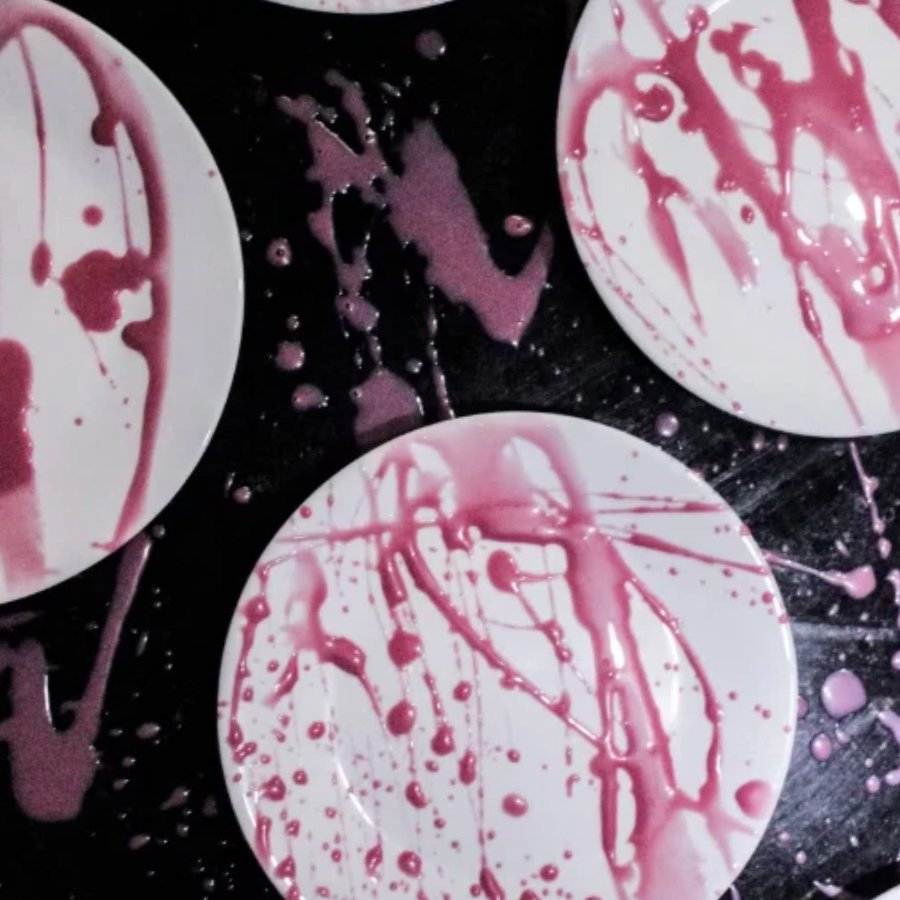
At times, the ordinary holds the extraordinary,
but only if we choose to look again.
Dilda White & The First Supper was a food-art performance that blurred the line between audience and performer, art and life. Rooted in the act of communal dining, it invited guests to challenge ritual, question etiquette, and step into a space where the sacred and the mundane could co-exist. It was a quiet act of rebellion—a table laid not just for eating, but for reimagining.

The Workshop
The experience began much earlier, with a workshop on mask-making conducted with underprivileged children. Through play and expression, the children unveiled not only creative masks but also the unseen masks of their lives, their food aspirations. Contrary to initial expectation, many children dreamed not of traditional fare, of burgers, but of glossy, brightly coloured pastries they often saw through bakery windows but could rarely access.
The Tablescape
Moved by these unheard preferences, we designed a dining experience as both reward and revelation. Probably for their first time, 13 children were invited to a formal sit-down meal—with elegant cutlery, glassware, and plated edible compositions inspired by their own food dreams. The table décor drew inspiration from The Last Supper, transforming the space into a symbolic setting for what we called The First Supper.
The Tables Turn
Staged in a dimly lit room, the meal unfolded as an edible performance. Two performers in crow personas—playful “kauvas”—darted around, attempting to snatch food, reflecting the constant tension between scarcity and desire. The children laughed, engaged, and participated with delight. Meanwhile, 40 guests watched from the other side of the glass cabin, observing, absorbing.
After the children finished eating, the guests were invited to enter the space. The room had shifted from spectacle to a site of reflection. Scrolls with poetry from Renaissance poets lined the scenography of the space. The table, a participatory stage with differential access to the 13 children and the 40 spectators, became an invitation for dialogue—about food, aspiration, access, privilege, and spectatorship. After the children were done eating, tea was served to the guests, and the guests were encouraged to interact with the space, the leftovers, and the children.
Should they click a picture, as is the norm while spectating? Or should they simply sit in that moment, unsure? How should they be interacting with those who have devoured a meal while they sat, watching? How does it feel to have the tables turned? The idea was to provoke a pause. Sometimes, to understand who we are, we must first unlearn how we eat.