How a Five-Course Immersive Theatrical Meal
Reimagined an Assamese Folktale
One long table. Twenty guests. Five courses. Three actors.
And a story that nearly every Assamese child has heard whispered by their grandmother.

The Story that Refuses to Die
Tejimola is a beloved Assamese folktale, first compiled by Laxminath Bezbaroa in Burhi Aair Xadhu (Grandmother’s Tales) in 1911. The story follows a kind, cherished girl named Tejimola whose stepmother, consumed by jealousy, begins to starve, humiliate, and control her. When Tejimola’s father leaves town, the cruelty intensifies until the stepmother forces her to work at the dheki, the traditional wooden rice pounder where grain is pushed forward into a pit and rhythmically pounded by foot with a long wooden lever. In a moment of unthinkable brutality, the stepmother crushes Tejimola’s hands under the pestle. She then forces her to use her feet to pound the rice, only to crush them too. Finally, she slams Tejimola’s head beneath the heavy wooden beam, killing her instantly, before burying her in the garden.
But Tejimola refuses to remain buried. She returns first as a gourd vine, then as a lemon tree, and finally as a lotus. With each resurrection, she weeps and sings, a lament carried by the winds of folk memory:
Hatu nemelibi lau nisingibi,
Kore khujoniya toi,
Pat kapuror logote mahi aai marile,
Tejimola hain moi.
Don’t pluck the gourd, oh traveller, what are you looking for?
My stepmother buried me for a piece of silk —
I am Tejimola, not a gourd.
With each song, she is recognised, and destroyed. Yet she returns again. She will not be silenced. When her father finally returns, he hears her voice and demands proof that it is indeed his daughter calling out to him. The lotus transforms into a dove, and then, at last, back into Tejimola herself. The stepmother, her cruelty finally exposed, faces her punishment.
The Dining Experience
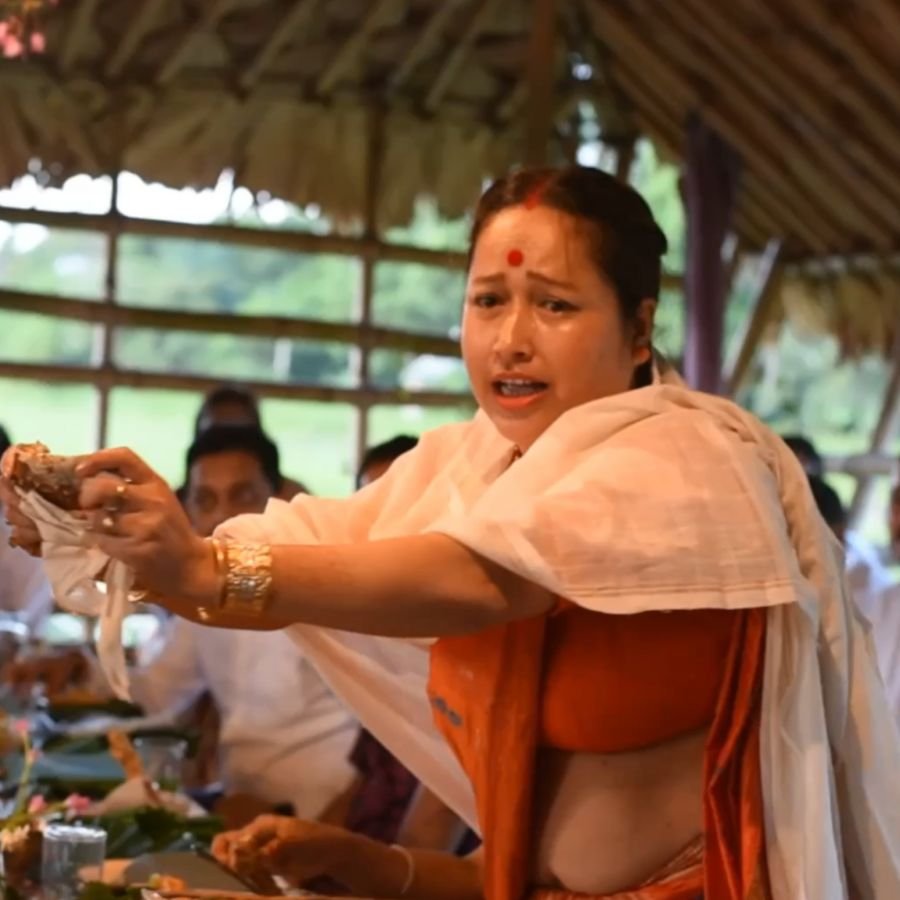
This was Tejimola, a dining performance hosted by Project Otenga, in collaboration with the artists of Theatary Rong Theatary Dhong, Dhemaji, Assam, that invited people not merely to hear a folktale, but to consume it, witness it, and carry it within themselves.The table transformed into a stage, each plate became a page, and food, warm, bitter, torn, shared, served as the living script.
For those who gathered in Dhemaji that evening, the meal offered far more than flavor. It offered a pathway to embody memory and understand that kitchen words like dheki (rice pounder), jhootha (half eaten food), and lauki (bottle gourd) carry more than culinary technique. They carry emotion. They carry the promise of return.


Course by Course
A Story in Five Dishes
The curation of the five courses was central to the enactment of the narrative. The story of Tejimola was broken down into substories and narrated during, and in the breaks between, courses. Each dish marked a turning point, with certain ingredients carrying symbolic weight. The food was crafted to help diners feel in their hands, throats, and depths the journey of turmoil and transformation Tejimola herself might have experienced.
Course 1
A House Divided
The meal opens in tension. The father sits at the table’s head while Tejimola moves quietly in the background. The stepmother’s voice cuts through the air:
“What have you cooked?” “Why is this taking so long?”
The food arrives warm and well- prepared, but the stepmother cunningly finds fault, unreasonably poking at perfection. The spices are thoughtfully added, yet she declares them too sharp. The atmosphere grows unsettled as guests sense the simmering resentment beneath the gentle music. This is a house divided, where control is encoded in both words and what appears on the plate, where even cooking with care becomes grounds for cruelty.
Course 2
Betrayal Wrapped in a Roti
The father departs. Tejimola is invited to a wedding. Her stepmother, unusually kind, gives her a parcel, with one condition: open it only at the venue. Tejimola obeys. But inside are torn clothes and broken ornaments. Humiliated, she borrows something to wear and returns home, dreading what comes next.
At the table, guests receive neatly folded roti parcels. But as they unwrap them, the illusion crumbles. The bread is torn, heavy, jagged. Something meant to comfort has turned cruel. These rotis symbolise betrayal, folded and served to elicit dejection. This is the moment when manipulation enters the mouth, the initiation into eating with grief and shame.


Course 3
The Dheki
This marks the story’s most brutal moment, when Tejimola is forced to labour at the dheki before being killed by it and later buried.
A miniature dheki sits at the table’s center, a prop that marks a looming, physical presence. The dheki, traditionally used to pound rice and nourish families, becomes an instrument of violence. Its weight presses heavily on the table, speaking without words. Guests eat slowly, carefully. Here, grief isn’t narrated, it’s tasted and swallowed.
Course 4
The Return to Life
From Tejimola’s grave, life pushes back against injustice. Sprouting, striving, a gourd vine emerges, then a lemon tree, then a lotus by the river. With the emergence of each of these life forms, Tejimola enters the world. Regardless of all sorts of trials and tribulations, the resurrection carries her voice that wavers, falters, and yet sings on.
The dishes presented in front of the guests mirror her rebirth: a lauki (bottle gourd) soup, soft and watery, evokes the vine’s quiet persistence. Next comes a sharp lemon chutney, bright and sour, full of defiance, marking her return, no longer silent but insistent. A spoonful of the chutney asks guests to remember her resilience, to carry her return.


Course 5
Jhootha
Tejimola’s father hears the lotus sing. Shocked, he challenges her to prove her identity, and so, she transforms from lotus to dove to daughter.
At the table, the actor portraying Tejimola removes her bird mask. She is no longer a metaphor, she is present tangibly. And the stepmother? Her punishment comes not through words but through jhootha (food that others have already touched). Leftovers from every guest’s plate are collected and served to her. She gags, resists, but ultimately eats. Justice isn’t declared; it’s served.


Why Food?
Why use food to tell a folktale? Because food is never neutral. What we eat, how we eat holds an entire range of emotion- rage and tenderness, shame and comfort. It carries memory in the form of technique, in the fold of a roti, the pale translucence of gourd, the weight of tools meant to nourish. We intended for this edible experience to be something more than a retelling of Tejimola, a re-feeling. Her story resonated not just in the script but in the awkward pauses between bites. She lived in the silence surrounding the dheki, the sourness of lemon, the watery softness of lauki.
This performance didn’t unfold in a white box gallery detached from the original context of the tale, but in Dhemaji itself, among neighbors, teachers, children, and elders. It is an ardent belief that we must return to our ways of knowledge-making, and that folk memory elicited through oral histories belongs at the table, in the household, on the streets, as much as in museums.
A Shared
South Asian Imagination
Though Tejimola is distinctly Assamese, the instinct behind this work transcends borders and kitchens. Across South Asia, whether it be in Tamil koothu, or Bengali panchalies, folk stories have always traveled through breath, rhythm, and body.
Certain kitchen words hold more than technique. They transcend their mundane purposes, to return and carry a deeper meaning.This meal employed dheki, lauki, and jhootha not merely as ingredients, tools, or concepts, but as emotional vessels, each allowing the body to feel what the tongue cannot always articulate.
And thus, the transformative saga of Tejimola continues to echo inspiration. She rose at our table, transforming twenty strangers into carriers of her tale, ensuring that her voice would travel home with each of them.